Cold-formed steel (CFS) wall panels are increasingly evaluated not simply as a material alternative, but as a project delivery strategy. From a client’s perspective, the decision is not about steel versus wood – it is about time-to-revenue, risk exposure, and long-term asset performance.
ARCCAN team approaches this through both design leadership. Based on industry research and supported knowledge from specialists at DMD Building Systems, prefabricated steel systems demonstrate measurable value when assessed through performance outcomes rather than material comparison.
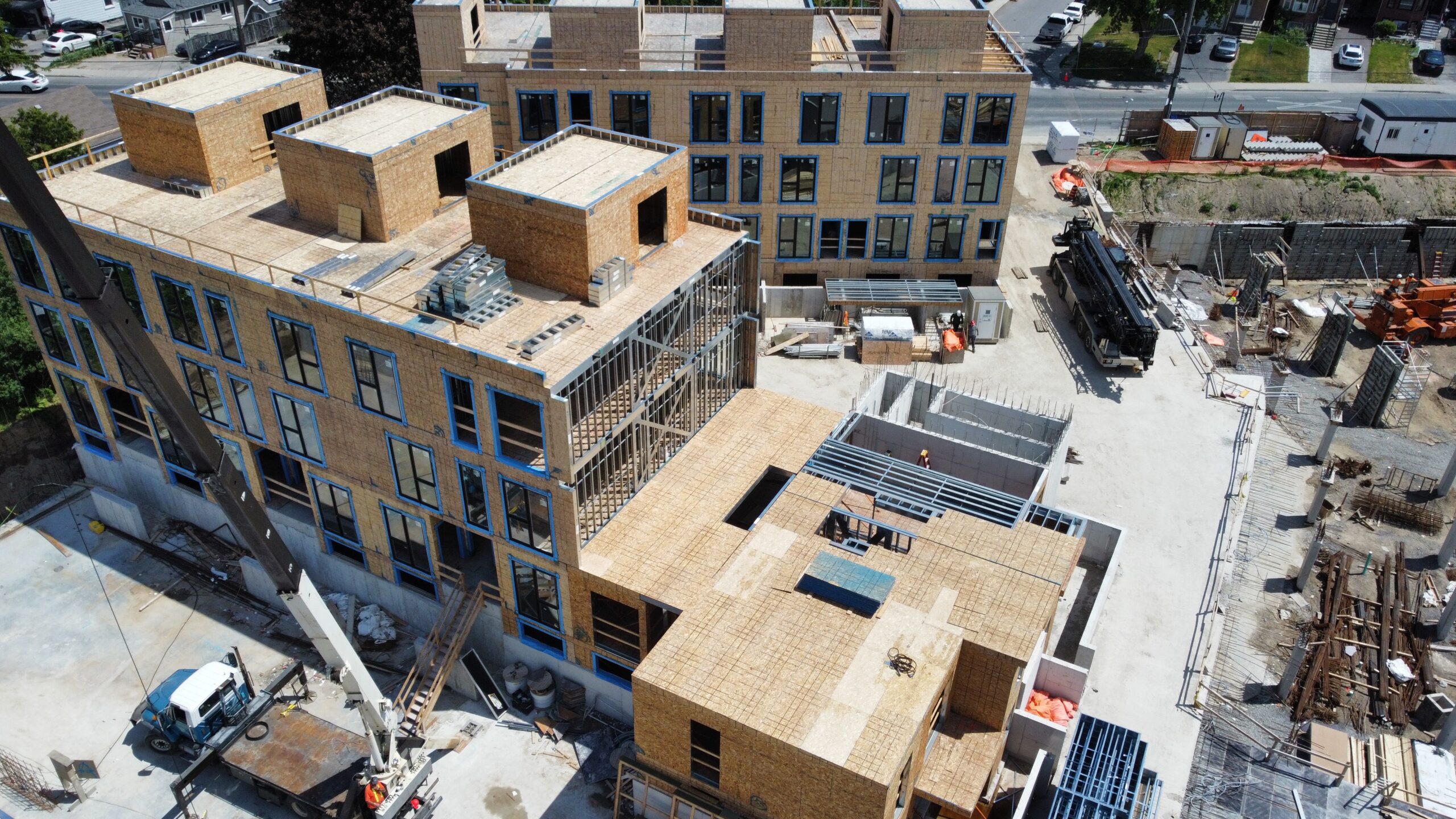
Stacked Town House Clonmore, Scarborough. Image courtesy of DMD Building Systems.
Faster Construction: Time-to-Revenue as a Primary Driver
For clients, construction speed directly impacts financial performance. Time saved during delivery translates into earlier occupancy, reduced financing costs, and accelerated revenue generation.
CFS wall panel systems can contribute to accelerated project delivery, particularly where early design coordination, prefabrication, and efficient site installation are properly implemented. The actual schedule improvement depends on project size, design complexity, coordination timing, site access, and installation sequencing.
Industry research indicates that modular and offsite construction methods can achieve 20 -50% schedule compression (McKinsey, 2019). This compression affects:
- Construction loan interest
- Site overhead and general conditions
- Leasing and operational timelines
Project-level data reinforces this trend. A case referenced by BuildSteel reports installation rates of 3 days per floor using CFS panels versus approximately 3 weeks for CMU construction, representing a significant reduction in cycle time. The same source cites a hotel project completing approximately 3 months earlier using cold-formed steel systems (BuildSteel, SFIA).
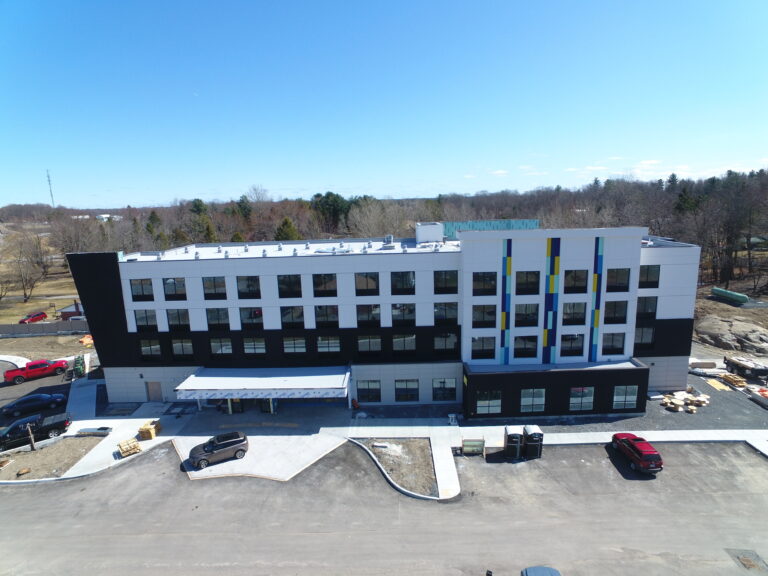
Tru by Hilton, Gananoque. Image courtesy of DMD Building Systems.
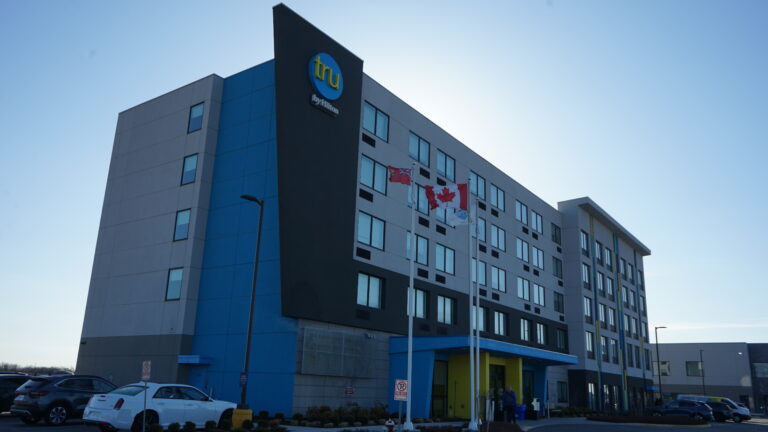
Tru by Hilton, Mississagua. Image courtesy of DMD Building Systems.
Lower Risk: Reducing Variability Through Prefabrication and Coordination
Construction risk is largely driven by variability – site conditions, coordination gaps, and late-stage design changes.
According to DMD, when CFS wall panels are modelled, engineered, and coordinated before fabrication, many potential conflicts can be identified before material reaches the field. This can reduce site coordination issues, improve dimensional accuracy, and limit the amount of rework required during installation.
In DMD’s experience, the greatest risk-reduction benefits come from:
- Early coordination with architectural, structural, and MEP drawings;
- Clear engineering responsibility for the CFS wall system;
- Accurate shop drawings and panel layouts;
- Prefabrication in a controlled production environment;
- Early identification of openings, slab edges, embeds, connection points, and interface conditions;
- Coordination of exterior sheathing, fire-rating requirements, deflection conditions, and structural load paths.
A peer-reviewed study in Results in Engineering reports BIM-related “investment rate” benefits of approximately 10 – 16%, demonstrating that digital coordination produces measurable project value (Results in Engineering, 2024). While not a direct measure of change order reduction, it validates BIM as a performance driver.
Industry sources and project case studies indicate that BIM coordination and prefabrication can reduce RFIs, field conflicts, and change-order exposure. However, the measurable reduction varies depending on the quality of the design documents, timing of trade coordination, project complexity, and the level of model integration.
These figures should be interpreted as indicative rather than universal, but they align with a consistent conclusion: better coordination reduces downstream risk.
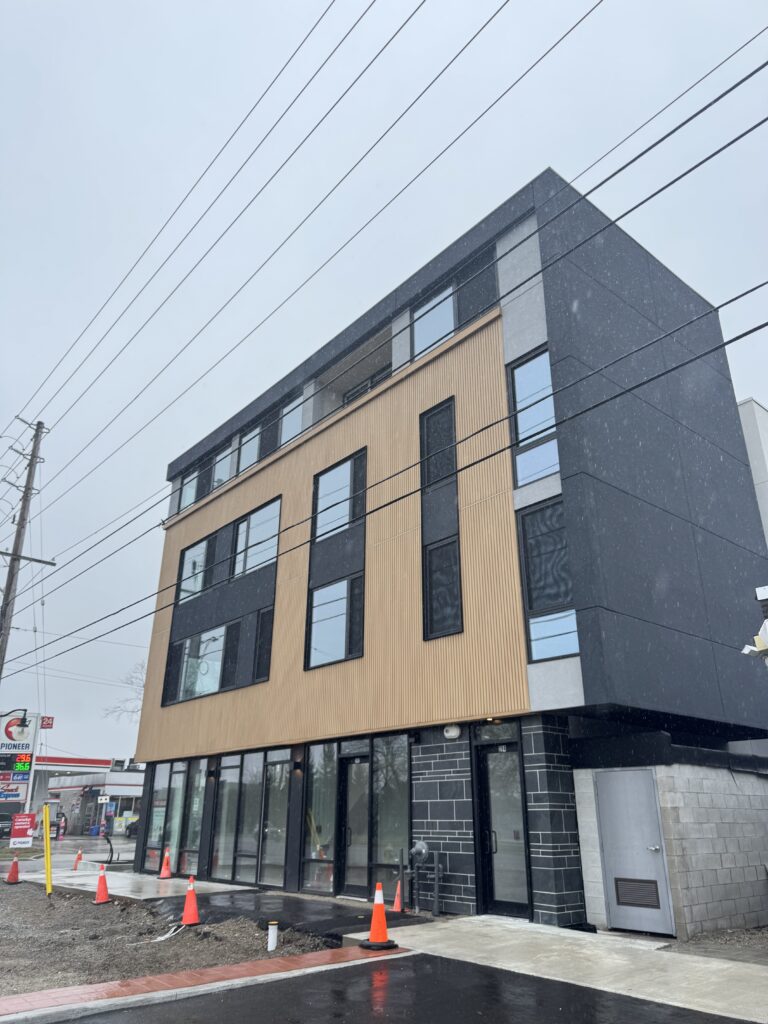
Brownsline Residential, Etobicoke. Image courtesy of DMD Building Systems
Better ROI: Lifecycle Performance and Asset Stability
While speed affects project delivery, durability defines long-term return on investment.
CFS offers strong long-term value because it is dimensionally stable, non-combustible, durable, and manufactured with consistent material properties. Unlike some traditional framing materials, steel does not warp, shrink, split, or rot. This supports better long-term performance, improved wall alignment, and reduced risk of movement-related issues when the system is properly designed and installed.
According to DMD Building Systems, cold-formed steel systems minimize shrinkage and warping while improving resistance to moisture, mold, and insects. These characteristics directly support long-term asset performance.
Industry sources further reinforce durability benefits. BuildSteel highlights the non-combustible nature of steel framing, including wildfire testing scenarios where steel-framed structures remained standing under extreme conditions (BuildSteel, SFIA). While this does not quantify lifespan, it demonstrates resilience and risk mitigation.
Precision manufacturing also contributes to quality. A BuildSteel case study reports 644 prefabricated panels installed in 17 working days (Hyatt Place project), illustrating repeatability and quality control that reduce field defects.Apart from the materials advantages, CFS benefits in other ways:
- Faster enclosure and project delivery
- Reduced site labour and site waste;
- Improved dimensional accuracy;
- Lower risk of moisture-related deterioration;
- Non-combustible construction advantages;
- Better long-term stability of the wall assembly;
- Improved coordination between structure, envelope, and architectural systems.
For developers and asset owners, these factors contribute to stronger lifecycle ROI, not just lower initial cost.
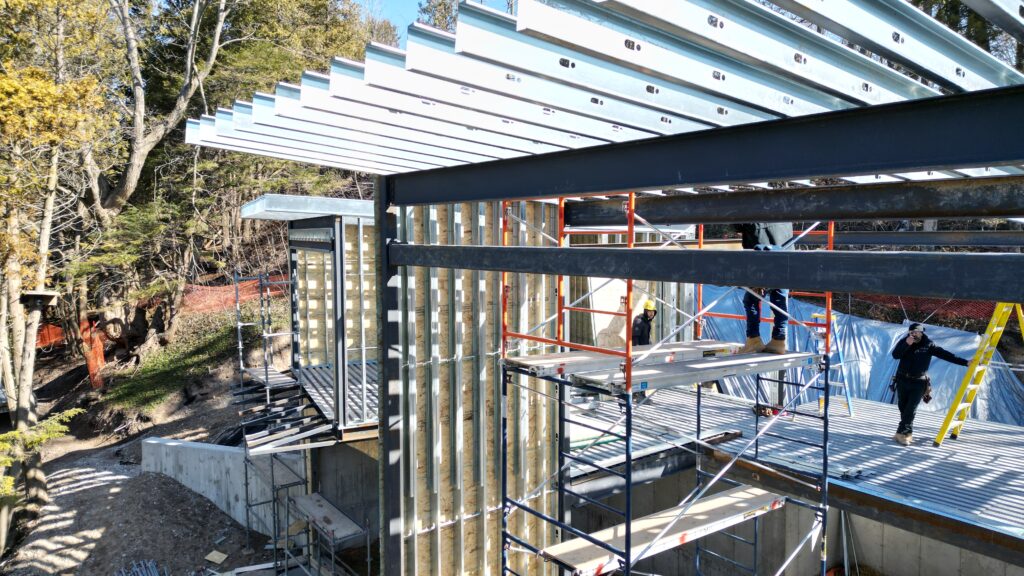
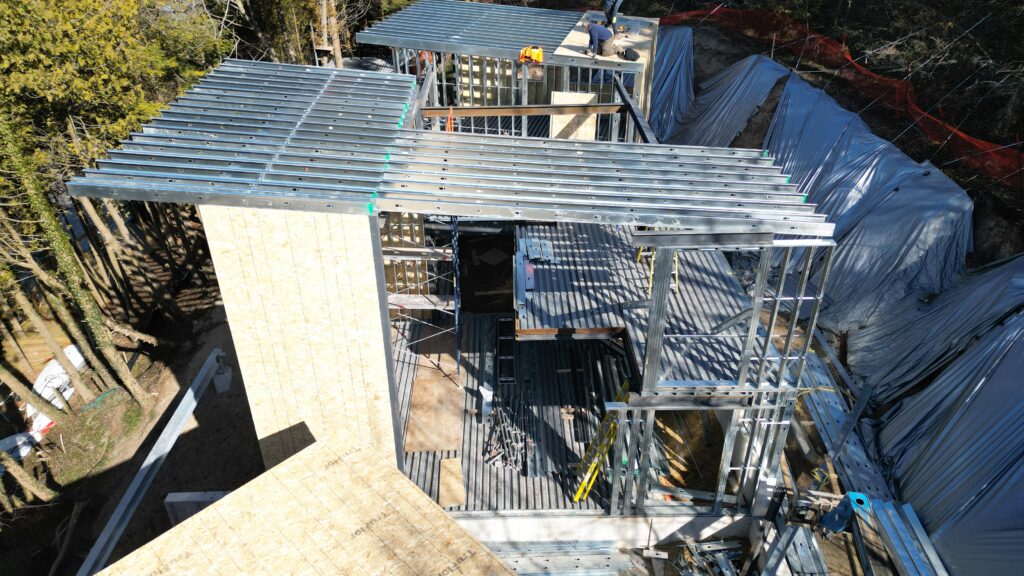
Rochon Cottage, Goderich. Image courtesy of DMD Building Systems.
Waste Reduction and Cost Efficiency
Construction waste impacts both project cost and environmental performance.
A peer-reviewed study (MDPI Buildings, 2021) found that modular construction can:
- Reduce total waste by up to 83.2%
- Reduce waste-related costs by approximately 47.9%
Additionally, a World Economic Forum (2025) study cites:
- ~3,700 fewer deliveries
- 56% reduction in vehicle movements
These improvements reduce site congestion and enhance schedule reliability.
Steel also supports sustainability objectives, with recyclability rates of up to 95% (DMD).
Waste Reduction and Cost Efficiency
Construction waste impacts both project cost and environmental performance.
A peer-reviewed study (MDPI Buildings, 2021) found that modular construction can:
- Reduce total waste by up to 83.2%
- Reduce waste-related costs by approximately 47.9%
Additionally, a World Economic Forum (2025) study cites:
- ~3,700 fewer deliveries
- 56% reduction in vehicle movements
These improvements reduce site congestion and enhance schedule reliability.
Steel also supports sustainability objectives, with recyclability rates of up to 95% (DMD).
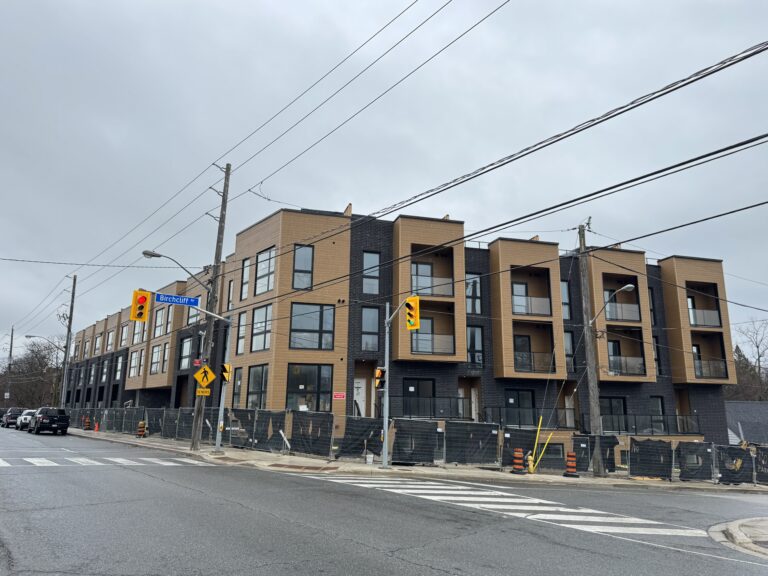
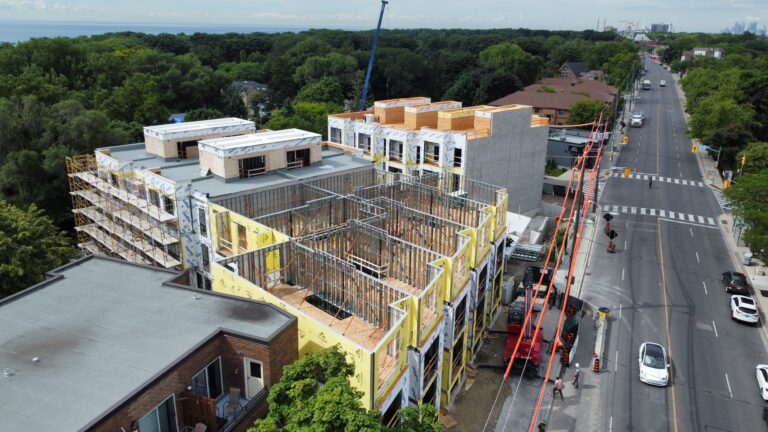
Stacked Town House Brichliff, Scarborough. Image courtesy of DMD Building Systems.
The Role of Prime Consultant Leadership with Building Information Modeling (BIM) Coordination
The benefits of cold-formed steel wall panels depend on how well decisions are resolved before fabrication. Prefabrication increases efficiency, but it also requires earlier and more accurate coordination.
A peer-reviewed study (Results in Engineering, 2024) confirms BIM-driven value through 10.17%–16.1% measurable benefits, reinforcing that coordination is not optional – it is a performance requirement.
McKinsey (2019) further states that modular success depends on optimizing the full chain of design, manufacturing, and logistics, aligning directly with the role of a prime consultant.
ARCCAN’s role as Prime Consultant:
We lead BIM coordination and constructability planning to resolve clashes and technical decisions before shop production. This reduces pre-fabrication risk, protects schedule certainty, and minimizes late-stage changes.
For clients’ benefits, this ensures prefabrication delivers its intended benefits rather than introducing new risks
Sustainability and Funding Readiness
CFS can support sustainability objectives because steel is recyclable, dimensionally stable, and well suited to prefabrication. Prefabricated panel systems can also reduce jobsite waste because materials are cut, assembled, and controlled in a production environment rather than handled entirely in the field.
Sustainability is increasingly tied to financing, approvals, and long-term asset value.
While no universal grant percentage can be confirmed for cold-formed steel systems alone, measurable outcomes support funding readiness and ESG alignment.
- Carbon Reduction: Up to 35% embodied carbon reduction in project-specific contexts (World Economic Forum, 2025)
- Waste Reduction: Up to 83.2% reduction in construction waste (MDPI Buildings, 2021)
CFS wall panel systems can support sustainability and ESG objectives through material efficiency, recyclability, reduced site waste, improved construction precision, and compatibility with prefabricated construction methods. These advantages may strengthen the project’s sustainability narrative and support documentation for green-building, ESG, or financing-related submissions, subject to the specific project criteria and supporting documentation required.
At ARCCAN, this is reinforced through our in-house Green Consultant, who integrates sustainability strategies early in design and supports certification and grant applications.
Sustainability becomes a financial and strategic advantage, not just an environmental goal.
Additional Technical Clarifications Recommended by DMD
To ensure optimal results for projects utilizing CFS construction, DMD also recommends:
- CFS wall panel systems should be engineered in accordance with the applicable building code and cold-formed steel design standards.
- Early coordination is essential. The best results are achieved when the CFS contractor is involved before the design is fully finalized.
- Fire-rating, acoustical, thermal, and envelope performance should be coordinated with the architect, fire consultant, envelope consultant, and applicable code requirements.
- Prefabrication does not eliminate the need for proper site review, tolerance coordination, and installation quality control.
- The strongest business case for CFS is achieved when schedule, risk reduction, site labour efficiency, lifecycle performance, and sustainability are considered together.
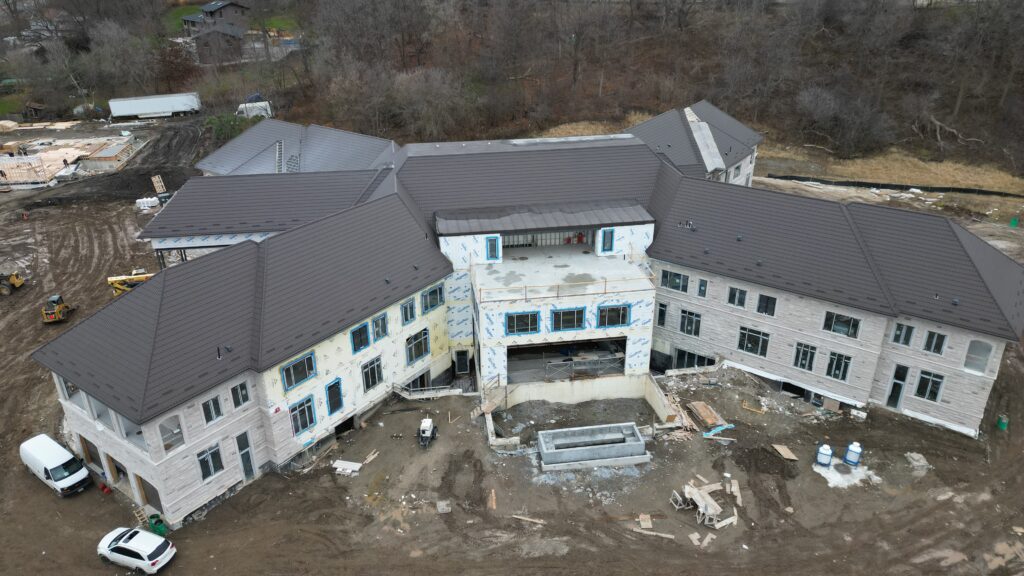
Custom Home, Brampton. Image courtesy of DMD Building Systems.
Conclusion: Measurable Impact on Time, Risk, and Return
When evaluated together, the data supports a clear conclusion:
- Time-to-Revenue:
Up to 20–50% faster project delivery, with documented cases of months saved, directly accelerating revenue generation. - Risk Exposure:
BIM coordination and prefabrication can contribute to 10–16% measurable project value improvements, with industry-reported reductions in RFIs (40–60%) and change orders (30–50%). - Long-Term Asset Performance (ROI):
Improved durability, reduced maintenance, and lifecycle stability supported by non-combustible materials and precision manufacturing. - Sustainability & Financial Positioning:
Up to 35% embodied carbon reduction and 83.2% waste reduction, strengthening eligibility for ESG-driven financing and grant applications.
Critically, these outcomes are not achieved by material selection alone. They are realized when cold-formed steel wall panels are combined with:
- Prime consultant leadership
- BIM-coordinated pre-construction
- Integrated sustainability strategy
At ARCCAN, this integrated approach ensures that speed, risk reduction, and long-term value are not theoretical advantages – but measurable project outcomes.
Sources:
- McKinsey & Company. (2019, June 4). Modular construction: From projects to products.
- BuildSteel (SFIA). 5 Reasons Why Cold-Formed Steel Can Save Time and Money.
- Results in Engineering (Elsevier)(2024). Quantifying the influence of BIM adoption.
https://www.sciencedirect.com/science/article/pii/S2590123024008107
- MDPI Buildings (2021). Quantifying Advantages of Modular Construction: Waste Generation.
https://www.mdpi.com/2075-5309/11/12/622
- World Economic Forum (2025). Modular construction & circularity.
https://www.weforum.org/stories/2025/01/modular-construction-productivity-circularity/
- DMD Building Systems
https://dmdbuilding.com/
https://www.dmdbuilding.com/benefits-of-dmd-wall-panel-system